
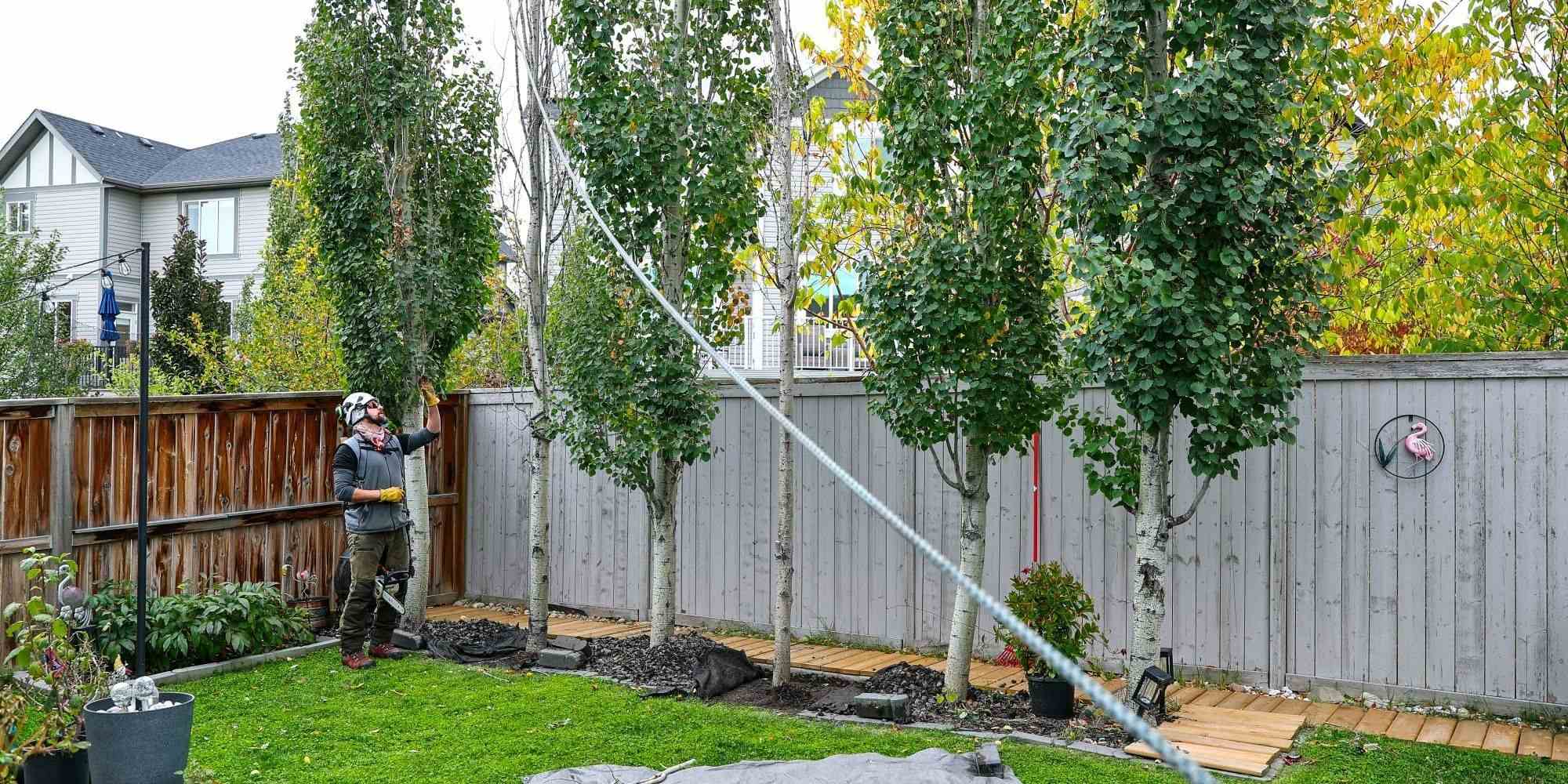
In our Summer issue, we ran a contest asking for Airdrie residents to submit a problem tree in their yard. There were some doozies, but Maureen Sexsmith-West, owner of Ladybug Arborist, was ready for the challenge.
“There are so many deserving candidates. This one was a good one where I felt we would be able to start and make a really noticeably transformed site within the budget. It was great because we were able to help educate the client on how to care for some of the other plants in her yard, and we look forward to helping her in the future,” says Sexsmith-West.
Follow the transformation in photos here:
Setting the stage. Before any tree work is done, we do a hazard assessment which includes moving any of the customer’s personal property that could be damaged during our work. In anticipation of doing stump grinding and planting, our team immediately moved all of the gravel mulch away from the trunk and pulled back the fabric. This also guarantees that our team’s tools aren’t going to be hitting rock.
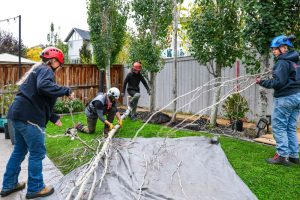
Given the windy conditions, it was advisable to install a tagline in the taller tree so we could direct it more accurately to the open location where it was going to land. We value both our client’s safety, and that of our employees.
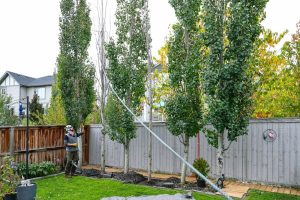
Here, Kyle is making the notch cut that will direct the tree accurately to the location on the customer’s lawn.
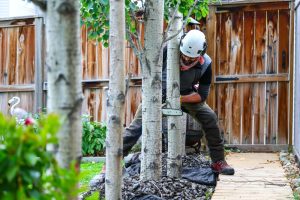
Once the tree is safely on the ground, our first priority is to remove the rope to ensure it isn’t cut by accident while we dismantle the branches from the trunk and [cut the wood] into transportable pieces to be hauled from the back to the front where our chipper is parked.
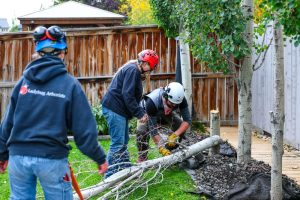
We’re using a tarp here to help keep the mess to a minimum and so that we can haul larger numbers of branches in one trip.
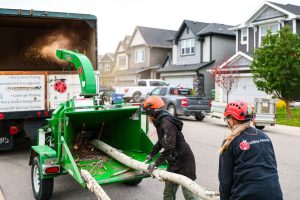
Here, Lea is feeding the chipper to dispose of the branches. Having a chipper is a real time saver It allows us to chip up multiple job sites before having to dump the truck. It can hold as much as six cubic yards of mulch. We try to recycle our wood chips.
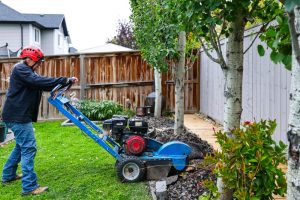
The next step is to grind out the stump. Caution is used because the trees are in close proximity [so] that we don’t accidentally damage any of the roots from any of the adjacent trees.
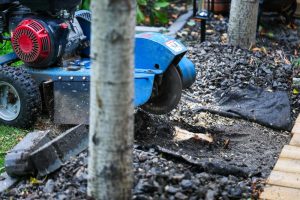
Making sure we grind carefully, we need to get deep enough to allow us to plant new shrubs that the customer has purchased to fill in the spots where the holes are.
Proper planting is critical to successful growing of any tree or shrub. Careful attention is paid to ensure that roots are feathered, as they are often girdling around in the pot. It’s essential to open up the roots so that they can grow out away from the host to give the plant the maximum access to nutrients, water and stability. Once planted, [we] will apply a transplant fertilizer to each one giving them a jumpstart, nutrients and all the things necessary to help strong roots develop.
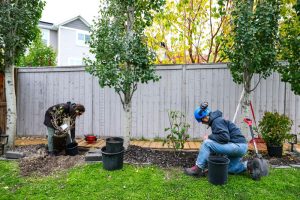
It’s like we were never there, leaving it better than we found it.
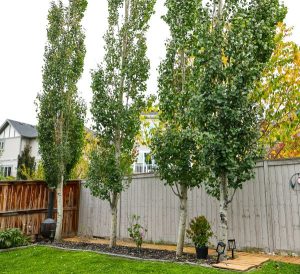
Here are some further comments from Sexsmith-West:
The summer of 2026 has presented an unusually large number of columnar, aspen and towering poplars in decline. I believe this is a [result] of our water restrictions last year, which makes the trees more vulnerable to insect and disease onset.
Very high cases of poplar borer bronze leaf disease have been the most frequent causes of three mortality this year. The difficulty for homeowners is that they buy a tree to provide quick coverage. Sadly, these are short-lived trees, typically only 25 or 30 years, that grow fast and leave all their defence mechanisms behind.
Having a monoculture often results in mass losses when serious threats like these two mentioned come into their yard. Some diseases become airborne. They can come from insects and they come from birds who can easily unwittingly transport problems from houses many streets over to yours.
The best solution is to have a diverse forest, rather than a linear planting of trees of the same age and species. There are so many other good columnar trees available at the garden centres that we highly encourage customers to investigate other options before they make the decision to plant.
Having a certified arbourist in your corner enables you to have a tree doctor with diagnostic skills [available who] can help determine whether problems are resolvable or not. Many of the real serious issues in this instance have no form of chemical remedy. Keeping your trees healthy, well watered and pruned correctly on a regular schedule will give your tree the best chance possible.
A certified arbourist will follow the industry standards to avoid topping and stubs.
Avoid storing or transporting infected or infected firewood at home or at your favourite camping destination are you may find yourself delivering or to their front door a new problem that they hadn’t had before. Buy it where you burn it.